
Chicken Road difficulty comparison
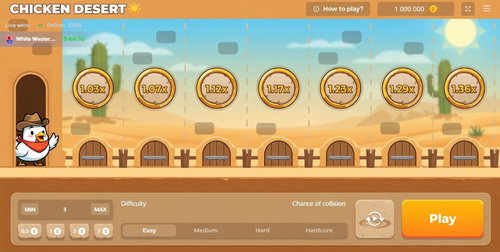
Chicken Road has four difficulty levels. Each changes how fast the multiplier climbs and how risky it feels. On easy the line moves more slowly; on hardcore it jumps faster. Choose based on experience and style.
| Level | Multiplier speed | Typical multiplier | Risk | Best for |
|---|---|---|---|---|
| Easy | Low — climbs slowly | ×2–×5 | Low | Beginners |
| Medium | Medium | ×3–×10 | Medium | Players who know the basics |
| Hardcore | High — climbs fast | ×5–×50+ | High | Experienced players, larger bankroll |
| Extra | Very high | ×10–×100+ | Very high | Experts |
What changes at each level
On easy the multiplier rises slowly. You have more time to decide when to cash out. The crash often comes later. Wins per round are smaller but steadier. Great for learning the flow.
On medium speed sits in the middle — a balance of risk and reward. A natural step once you have a few sessions under your belt.
On hardcore the multiplier moves fast. The crash can land anytime — but when you time it right, multipliers can get big (×20, ×50, ×100). Higher risk, higher upside. For players who know the game and can handle losing streaks.
On extra speed is maxed out. For experts only.
"I started on easy. When I felt comfortable I moved to medium. I tried hardcore in demo first. I still do not use it for real."
— Carmen R., Kochi
"Hardcore is where the big wins live — and the big losses. I cap myself at $20. If I lose it, I walk."
— Fernando T., Ahmedabad
When to move up a level
When you really understand how your current mode behaves. On easy: you know when to cash out, you have won and lost enough rounds, and you feel in control. Then try medium.
On medium: you finish sessions without tilting and you know basic strategies. Test hardcore in demo first. If it feels OK, try small real stakes.
There is no rush. If you are unsure, stay on the easier mode. Losing on hardcore stings more than on easy.
Strategies by level
Easy: conservative play. Cash out around ×2–×5. Longer sessions, smaller but steadier wins.
Medium: conservative or automatic. Auto cash out at ×3 or ×4 works well.
Hardcore: aggressive tactics only if your bankroll can take it. A session limit is a must. The multiplier moves fast and losses stack quickly.
More detail in our strategy guide.
Which should you pick?
Beginners: start on easy or medium. Practice on free demo before playing for real.
Experienced players: try hardcore if you want big multipliers — always with a limit.
Auto cash-out and difficulty together
Auto cash-out is useful on every tier, but it shines on hardcore and extra where manual clicks lag behind the curve. Set a realistic target (many players start near ×2–×3) and let the software execute. On easy, you might prefer manual play because you have breathing room to change your mind — just do not confuse slow motion with better odds.
Difficulty does not replace bankroll maths
Moving to easy does not magically stretch a $500 budget if you triple the stake to feel excitement. The safe approach is: lower mode + smaller bet or higher mode + tiny bet. If both climb together, you are only increasing volatility. Our limits FAQ pairs well with this page when you size stakes.
Practice plans that actually work
Spend at least one session per mode in demo before judging it. Note how many seconds you typically wait before cashing out. If hardcore makes you panic-click, that is data — not failure. Some players keep a notes app with “max comfortable multiplier” per mode and revisit monthly as skill improves.
Extra mode: last warnings
Extra is not a badge of honour; it is the fastest curve on the menu. Use it sparingly, with a hard stop-loss, and never because you are angry after losses. If you want detail on surviving fast modes, read hardcore FAQ — the mindset overlaps.
Suggested learning path
| Stage | Mode | Goal |
|---|---|---|
| Day 1–2 | Easy + demo | Learn buttons and crash timing. |
| Next | Medium + demo or tiny real stakes | Feel slightly faster curve. |
| Later | Hardcore + strict limits | Only if calm on easier tiers. |